Vulnerability Management Framework: How to Meet CRA & NIS2 Requirements Efficiently



A clear vulnerability management framework helps you move from scattered findings to controlled action. Instead of reacting to alerts one by one, you can assign ownership, prioritise real risk, verify fixes, and retain evidence across releases. For connected products, this approach is essential for meeting CRA and NIS2 requirements efficiently.
Key Takeaways
- A vulnerability management framework turns scattered findings into a repeatable process from discovery to closure.
- CRA and NIS2 increase pressure to identify, remediate, and document vulnerabilities.
- Product cybersecurity requires a different approach from traditional IT security.
- Risk scoring should combine severity with exploitability and business context.
- Continuous monitoring is vital because new CVEs can affect products after release.
- Automation reduces manual effort and improves audit readiness.
- ONEKEY helps unify product security and compliance across the lifecycle.
Definition: What Is a Vulnerability Management Framework?
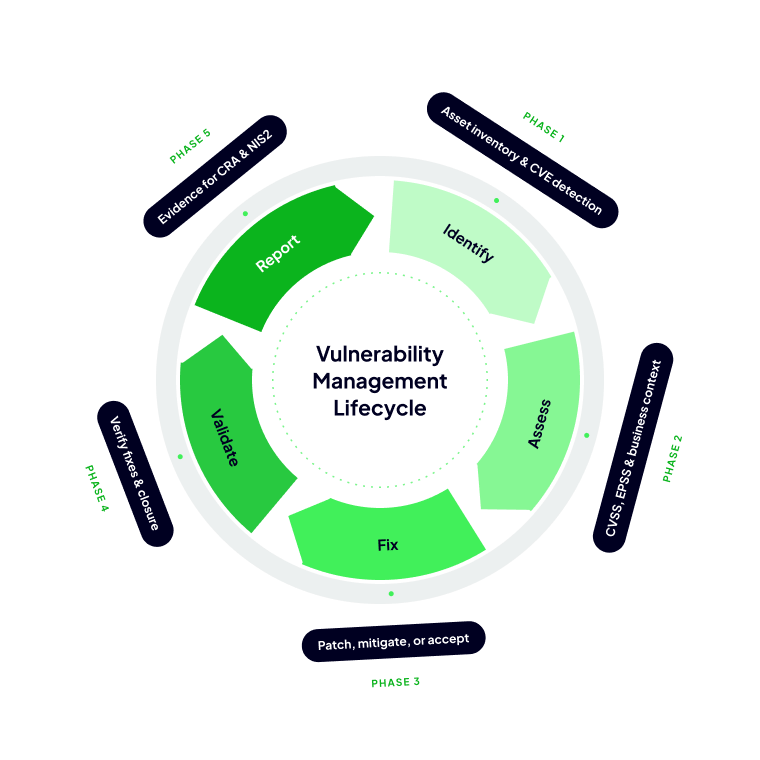
A vulnerability management framework is a structured process for identifying, assessing, fixing, validating, and reporting security weaknesses. It replaces reactive actions with clear ownership, timelines, evidence, and repeatable decision-making. This helps you reduce exposure in a consistent and measurable way. It also gives teams a shared model for handling future risk.
For connected products, the process goes beyond standard IT scanning. Devices may run firmware, use third-party components, and remain in service for years. They may also be difficult to patch once deployed, especially where uptime or safety matters.
Many teams use the term vulnerability management when they only mean scanning. Scanning can identify possible issues, but it does not create ownership, prioritisation, remediation, or proof of closure. A full framework connects those steps into one controlled process.
Core Components of a Vulnerability Management Framework
Most programmes follow the same core stages, even if the names differ. The goal is to create a repeatable cycle from discovery to closure. Each stage supports stronger control, faster decisions, and better compliance outcomes.
1. Continuous Asset Inventory
You cannot manage risk without knowing what you own. Start with a live inventory of products, models, firmware versions, deployed assets, and software components. This creates the baseline needed for faster decisions and cleaner reporting. It also reduces confusion during urgent security events.
Connected products often contain supplier code and hidden dependencies. A single vulnerable library may affect multiple versions at once. Understanding what an SBOM is helps you trace components quickly and assess exposure with confidence.
2. Vulnerability Detection – Binary-First CVE Analysis
Detection should go beyond basic scanning. Binary analysis can identify components and weaknesses even when source code is unavailable. This is useful for embedded devices, third-party software, and released firmware. It gives you broader visibility across the real product environment.
Raw alerts should never be treated as final truth. Findings must be checked against your exact version, configuration, and attack surface. Automated vulnerability management helps reduce noise and focus teams on genuine risk.
3. Risk Assessment and Prioritization – CVSS, EPSS, and Business Context
Not every vulnerability needs the same response. A medium issue in a safety-critical device may matter more than a high issue in a test environment. Context should guide action, not headline scores alone. This helps limited resources focus on the greatest risk first.
Use a model that blends technical severity with business impact. Common factors include CVSS, EPSS, exploit likelihood, customer effect, and regulatory urgency. The NIST cybersecurity framework vulnerability management approach supports this type of prioritisation.
4. Remediation Workflows – Patch, Mitigate, or Accept
After triage, findings should move into controlled workflows. Some issues need a patch, some need temporary mitigation, and some may be formally accepted with approval. Each path needs ownership, deadlines, and clear governance. This prevents issues from sitting unresolved.
Security teams may identify the issue, but engineering often owns the fix. Product teams may also control release timing and communication. Strong vulnerability management depends on shared visibility across these groups.
5. Continuous Monitoring – Tracking New CVEs After Release
Risk does not end when a product ships. New CVEs may affect components already inside released devices months or years later. Without monitoring, exposure can remain hidden for long periods. This creates avoidable operational and compliance risk.
Continuous monitoring links new disclosures to your installed base and component data. A reliable SBOM management tool helps trace affected versions quickly and improve response speed. It also gives teams stronger evidence during audits.
6. Compliance Reporting – CRA, IEC 62443, and NIS2
Security work needs evidence, not only activity. Regulators, customers, and auditors may ask what was found, what was fixed, when it was addressed, and which versions were affected. Rebuilding that history later is slow and risky. Good records prevent last-minute audit pressure.
Strong reporting keeps findings, remediation dates, accepted risks, validation results, and responsible owners in one place. This supports internal governance as well as external reviews. Framework alignment may also support standards such as IEC 62443 where relevant.
The Most Widely Used Vulnerability Management Frameworks
Several recognised frameworks can help structure your programme. Each has strengths depending on your environment, maturity, and regulatory needs. Many organisations combine more than one model to cover governance and product security.
The NIST cybersecurity framework vulnerability management model is a practical starting point for many teams. It is flexible, recognised, and easy to map to existing controls. Product manufacturers often extend it with product-specific workflows.
ISO 27001 & IEC 62443 – Frameworks for OT/IoT environments
ISO 27001 and IEC 62443 are often used in environments where operational technology and connected products play a major role. ISO 27001 focuses on governance, risk management, and security processes across the organisation. IEC 62443 is more specialised and supports industrial systems, embedded devices, and operational technology environments. Many manufacturers use both frameworks together to strengthen governance and technical security.
For connected products, IEC 62443 is especially useful because it addresses long product lifecycles, supplier risk, and secure system design. This aligns well with the needs of manufacturers managing industrial devices and IoT ecosystems. Teams often combine these frameworks with internal processes to support CRA and NIS2 requirements.
CVSS & EPSS – Scoring Frameworks for Vulnerability Prioritizations
Vulnerability scoring frameworks help teams decide which issues need immediate attention. CVSS measures technical severity using factors such as attack complexity, impact, and required privileges. EPSS estimates the likelihood that a vulnerability will be exploited in the real world. Using both models together creates stronger prioritisation.
High CVSS scores do not always mean high operational risk. Some vulnerabilities may score lower technically but still create serious exposure because of internet access, customer impact, or exploit activity. A mature vulnerability management framework combines scoring models with business context to support better decisions.
Best Practices for Implementing a Vulnerability Management Framework
Implementation works best when you focus on process, ownership, and evidence rather than tools alone. Technology enables scale, but governance creates consistency. Start with a practical model that teams can follow and improve over time.
Build security tasks into existing delivery workflows so teams can work in familiar systems such as Jenkins, Jira, and Splunk. This reduces friction and helps remediation happen faster. Clear ownership also improves accountability.
Define service levels for triage, remediation, validation, and escalation. Critical exploitable issues may need immediate action, while lower-risk items can align with planned releases. Realistic targets help security work support delivery instead of disrupting it.
Traditional IT security models are often too narrow for connected products. Devices may be remote, long-lived, safety-linked, or difficult to patch once deployed. Your vulnerability management framework should reflect product realities rather than office IT assumptions.
Useful implementation priorities include:
- Clear ownership for each product or release
- Risk-based prioritisation rules
- Evidence retention for audits
- Continuous monitoring after release
- Workflow integration across teams
- Regular process reviews
Conclusion: How ONEKEY Supports a Vulnerability Management Framework
A strong vulnerability management framework turns scattered findings into measurable progress. With accurate visibility, risk-led prioritization, verified fixes, and clear evidence, you can reduce exposure while supporting CRA and NIS2 compliance. For connected products, that discipline is essential because vulnerabilities often persist long after release.
ONEKEY helps you manage this process end to end across the product lifecycle. Its platform supports binary analysis, vulnerability detection, SBOM generation, continuous monitoring, workflow integrations, and compliance reporting. That means less manual effort, faster decisions, and stronger audit readiness.
What role does the NIST framework play in vulnerability management?
The NIST framework gives you a recognised structure for identifying, protecting, detecting, responding, and recovering. It supports risk-based decisions instead of one-size-fits-all controls. Many organisations use it as the foundation of their programme.
What are the 4 phases of a Vulnerability Management Framework?
Many simplified models use four phases: identify, assess, remediate, and monitor. Some organisations also separate validation and reporting into their own stages. The best model is one your teams can run consistently.
Why is a Vulnerability Management Framework important?
Without a framework, findings often sit in queues with no owner or timeline. A structured process improves accountability, speed, and evidence retention. It also supports compliance and customer trust.
How is vulnerability prioritisation automated in a Vulnerability Management Framework?
Automation combines data such as severity scores, exploit likelihood, asset criticality, and business impact. Findings are then ranked into actionable queues. This helps teams focus effort where risk is highest.
About Onekey
ONEKEY is the leading European specialist in Product Cybersecurity & Compliance Management and part of the investment portfolio of PricewaterhouseCoopers Germany (PwC). The unique combination of the automated ONEKEY Product Cybersecurity & Compliance Platform (OCP) with expert knowledge and consulting services provides fast and comprehensive analysis, support, and management to improve product cybersecurity and compliance from product purchasing, design, development, production to end-of-life.

CONTACT:
Sara Fortmann
Senior Marketing Manager
sara.fortmann@onekey.com
euromarcom public relations GmbH
team@euromarcom.de




Ready to automate your Product Cybersecurity & Compliance?
Make cybersecurity and compliance efficient and effective with ONEKEY.