Threat Modeling in the SDLC: A Strategic Guide for Product Security



Threat modeling helps you identify and address security risks before they turn into costly problems. For connected products, it brings visibility into weak points across firmware, supply chains, and architecture. This guide shows you how to embed threat modeling into your SDLC to meet security, compliance, and product quality goals. With the right tools and approach, you can make security a part of your workflow, not a roadblock.
Key Takeaways
- Threat modeling is a structured, proactive method for identifying and mitigating security risks early in the SDLC, rather than reacting to issues after release.
- It is most effective when started in the design phase but should be continuously updated throughout development, testing, release, and maintenance.
- Modern threat modeling must account for software supply chain risks, including third-party components, firmware, and “black box” dependencies, ideally alongside SBOM management.
- Effective threat modeling is team-based and benefits from automation, clear risk prioritization, and integration with CI/CD and existing engineering workflows.
- It supports regulatory compliance (e.g., CRA) by providing traceability, documented risk assessment, and evidence of security-by-design practices.
- When paired with automated platforms (e.g., tools like ONEKEY), threat modeling becomes scalable, continuously updated, and tightly linked to vulnerability management and incident response.
What is Threat Modeling in the SDLC?
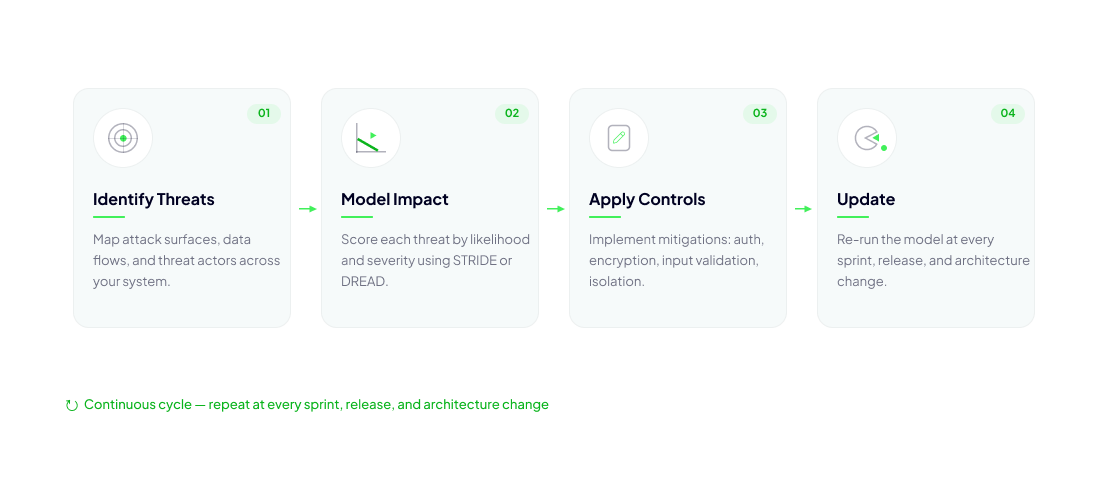
Threat modeling is a structured way to identify potential threats in your system before attackers do. In the SDLC, it helps you plan, prioritise, and defend against risks early in the development process. When done right, it keeps security aligned with design and delivery, improving product quality and resilience.
It answers questions like:
- What could go wrong?
- Where are the weak spots?
- How do we fix them?
You look at your product from an attacker's point of view. Then, you create controls to prevent or reduce the impact of those threats. It’s a mindset and repeatable process that adapts as your product evolves.
Why Does Threat Modeling in SDLC Matter Today?
Connected products face increasing pressure from both attackers and regulators. Without early security planning, you risk costly delays, rushed fixes, or missed compliance milestones. Threat modeling avoids this by catching issues before they reach production.
Standards like the Cyber Resilience Act (CRA) now demand proactive security. Threat modeling shows that you’ve considered threats throughout development. It builds trust with both customers and auditors.
It also aligns technical teams around shared risks and priorities. Developers, testers, and compliance managers all work from the same threat picture. This improves coordination and speeds up fixes.
Threat Modelling in Which Phase of SDLC?
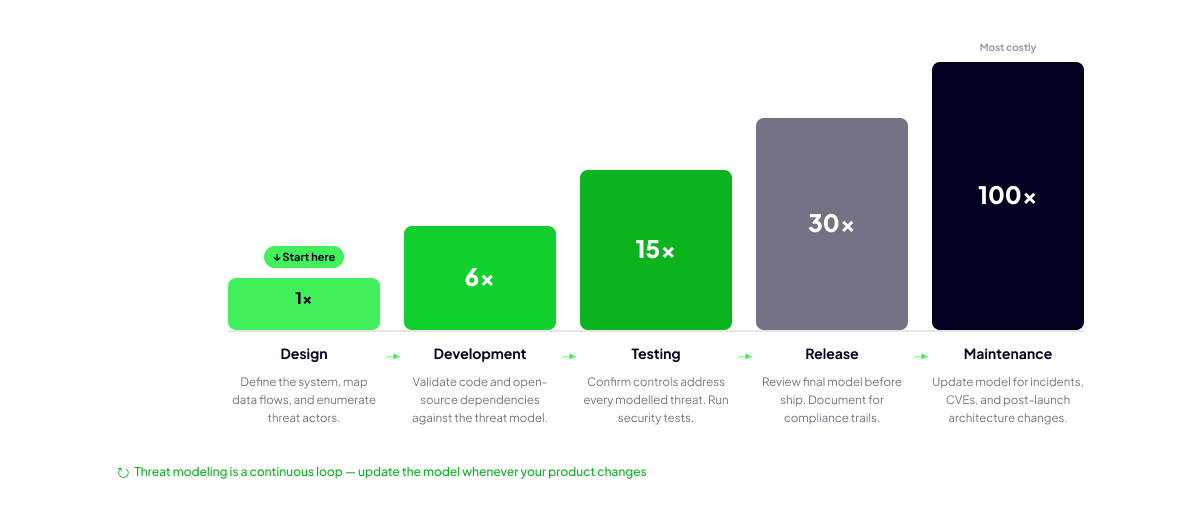
The earlier you begin, the better. Threat modeling is most effective during the design phase when making changes is fast and low-cost. But it should continue throughout development and maintenance.
Each SDLC phase brings new risks. In development, you validate code and open-source dependencies. In testing, you confirm that controls address modelled threats. After release, you update your model in response to new CVEs or product changes.
Bridging the Gap: Integrating Threat Modeling with Supply Chain Security
Today’s products rely heavily on third-party components, many of which act as black boxes. Threat modeling helps you understand what risks are inherited through the supply chain. You identify trust boundaries and areas where control is limited.
This includes external firmware, libraries, APIs, and even hardware dependencies. By modelling how data and privileges flow across these, you uncover hidden risks. It also guides decisions on isolation, validation, or replacement.
Combining this process with a SBOM management tool improves visibility further. It lets you monitor third-party components and detect changes that could introduce vulnerabilities. This keeps your threat model connected to real-world supply chain risks.
Strategic Best Practices for Effective SDLC Threat Modeling
A strong threat modeling process fits into your SDLC without slowing it down. The goal is to create a repeatable, actionable workflow that keeps teams aligned. These best practices make it easier to implement across product teams.
Automate Threat Modeling
Manual modeling takes time and deep expertise. Automation helps scale your process, flag regressions, and keep threat models updated with each release. It also reduces reliance on security specialists for every step.
Key benefits include:
- Continuous integration with CI/CD tools
- Reusable models across similar components or projects
- Better traceability for audits and reviews
Look for tools that connect with version control and ticketing systems. This lowers the barrier to adoption and fits into how teams already work.
Involve the Right Stakeholders
Threat modeling works best when it’s a team sport. Developers, architects, testers, and product owners all bring different insights. This leads to more complete models and stronger buy-in.
Encourage early participation in planning or refinement sessions. Assign a facilitator who can guide the process and follow up on actions. This ensures the model is acted upon, not just filed away.
Risk Prioritization
Not all threats need to be fixed right away. Prioritise based on likelihood, impact, and exposure. This helps focus resources where they matter most.
Use scoring systems or heat maps for clarity. Link your priorities to compliance or business goals. Review your model regularly to reflect changes in code or supply chain components.
Role-Specific Benefits: Why Each Leader Needs Threat Modeling
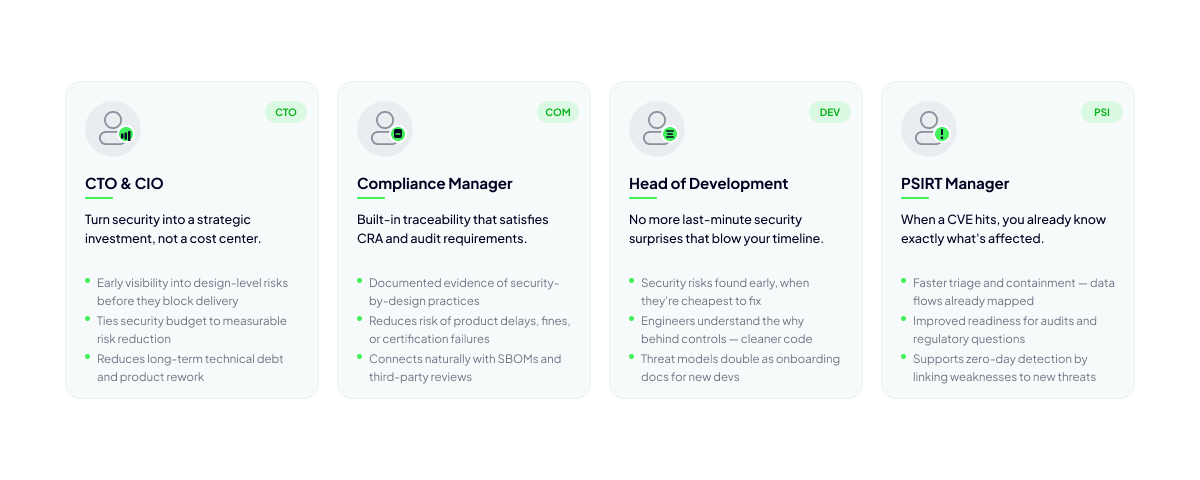
Different roles benefit from threat modeling in different ways. Understanding these benefits helps you drive adoption across your product and security teams. It also improves collaboration across departments.
CTO & CIO
For technology leaders, threat modeling reduces technical debt and improves long-term product resilience. It offers early visibility into design-level risks that could block innovation or fail compliance. This allows you to balance speed with safety.
Threat modeling also helps justify security investments with tangible examples. You can tie budget to risk reduction and trace progress over time. It becomes a strategic enabler, not just a defensive move.
Product Compliance Manager
Compliance teams rely on documentation and traceability. Threat modeling provides both. You can show that your teams identified risks early and planned mitigations from day one.
This aligns with the CRA and similar regulations. It demonstrates governance and reduces the risk of product delays or fines. It also connects well with SBOMs, licences, and third-party reviews.
Head of Development
Threat modeling helps development leads avoid last-minute surprises. It reveals security risks early, when they’re cheapest to fix. This keeps delivery timelines stable.
It also brings your engineers closer to security goals. Developers understand the “why” behind controls, which leads to cleaner implementations. Models can also serve as onboarding tools for new developers.
PSIRT Manager
For PSIRTs, threat modeling brings clarity during high-stress events. When a CVE hits, you already know which components are affected and how data flows through them. This speeds up triage and containment.
Benefits include:
- Shorter incident response times
- Improved readiness for audits or questions
- Better handling of complex supply chain exposures
It also supports zero-day attack detection by linking known weaknesses to emerging threats. That gives your team a head start when speed matters.
Common Pitfalls in SDLC Threat Modeling
One common mistake is treating threat modeling as a one-time task. Without updates, the model becomes outdated and less useful. It should evolve as the product changes.
Overcomplicating the process is another trap. Teams may delay or skip modeling if it's too hard to use. Start simple and improve as your teams gain confidence.
Lastly, some organisations assign threat modeling to one person or silo. It works best when it’s cross-functional and embedded across teams. That’s how it stays relevant and effective.
Scaling Your Security Strategy with ONEKEY
Threat modeling becomes even more powerful when paired with automation and visibility. ONEKEY helps you scale your strategy without increasing manual effort. It integrates with your SDLC to link models, vulnerabilities, and compliance goals.
With ONEKEY, you can:
- Analyse device architecture and firmware binaries
- Detect vulnerabilities and compliance gaps automatically
- Monitor for changes across the product lifecycle
The platform connects with tools like Jenkins, Jira, and GitLab. This ensures security stays aligned with engineering workflows. It turns threat modeling into a living part of product delivery.
Conclusion: Making Security a Competitive Advantage
SDLC threat modeling turns security into a proactive design choice. It helps teams move faster by avoiding late-stage rework and compliance surprises. It also builds confidence across leadership, engineering, and compliance.
The process doesn’t need to be perfect from the start. What matters is that it's repeatable, shared, and updated. That’s how you make security a competitive advantage.
How often should threat models be updated?
You should update your threat models with every major product change. This includes new features, architecture updates, or external integrations. Regular updates keep your risk view accurate and useful.
How does SDLC threat modeling help with Cyber Resilience Act (CRA) compliance?
It shows that you've proactively identified and managed risks. This aligns with CRA expectations for security-by-design. It also supports traceability for audits and certification.
Can we automate threat modeling for IoT and Embedded systems?
Yes, automation is essential for scaling threat modeling. It helps analyse device architecture, known vulnerabilities, and binary behaviours. It also supports fast feedback loops in development.
What is the difference between Threat Modeling and a Penetration Test?
Threat modeling happens early and focuses on design-level risks. Penetration tests come later and identify actual vulnerabilities through simulation. Both are valuable and should work together.
Does Threat Modeling require a dedicated security expert for every team?
No, a full-time expert isn’t required for every group. A facilitator can guide the process while others contribute system knowledge. The best results come from cross-functional input.
Can we apply threat modeling to third-party “Black Box” software?
Yes, especially when combined with binary analysis. You can still model data flows, entry points, and trust boundaries. This helps you manage supplychain risks even without source code.
How do we measure the success of our threat modeling activities?
Track coverage, updates, and real-world impact. Success means identifying key risks early and reducing issues downstream. If teams are using the model and acting on it, you're on the right path.
About Onekey
ONEKEY is the leading European specialist in Product Cybersecurity & Compliance Management and part of the investment portfolio of PricewaterhouseCoopers Germany (PwC). The unique combination of the automated ONEKEY Product Cybersecurity & Compliance Platform (OCP) with expert knowledge and consulting services provides fast and comprehensive analysis, support, and management to improve product cybersecurity and compliance from product purchasing, design, development, production to end-of-life.

CONTACT:
Sara Fortmann
Senior Marketing Manager
sara.fortmann@onekey.com
euromarcom public relations GmbH
team@euromarcom.de




Ready to automate your Product Cybersecurity & Compliance?
Make cybersecurity and compliance efficient and effective with ONEKEY.