Software Supply Chain Security Best Practices: A Strategic Guide for Product Leaders



Software supply chain attacks are growing. You need to know what’s in your code, who built it, and how it’s secured. This blog helps you understand software supply chain security best practices, so your products stay compliant, trusted, and safe.
Key Takeaways
- Software supply chain security is now a regulatory requirement, driven by frameworks like the Cyber Resilience Act (CRA) and NIS2, which demand transparency and traceability of software components.
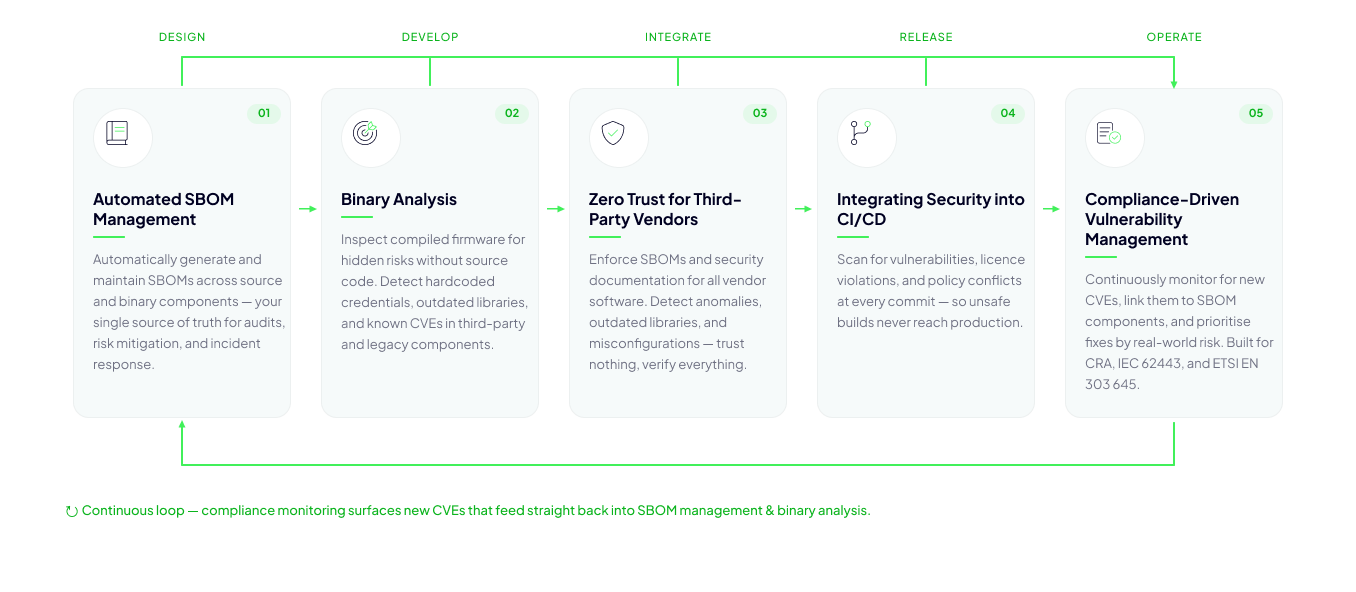
- A strong security strategy rests on five pillars: automated SBOM management, binary analysis, zero-trust for vendors, security integrated into CI/CD, and compliance-driven vulnerability management.
- SBOMs (Software Bills of Materials) provide a single source of truth about what is in your software, helping teams track components, vulnerabilities, and changes over time.
- Binary analysis is essential for securing third-party, legacy, or closed-source components where source code is unavailable, reducing blind spots in the supply chain.
- Embedding security directly into CI/CD pipelines enables earlier detection of risks, faster releases, and smoother compliance with security regulations.
- Effective software supply chain security requires shared responsibility across roles, engineering, security, compliance, and leadership, rather than siloed ownership.
Why Software Supply Chain Security is Mandatory: From Risk to Regulation (CRA & NIS2)
Connected products are vulnerable by design. From reused code to third-party libraries, your software supply chain may hide unseen risks. Ignoring them can expose your business to compliance failures, downtime, and attacks.
Regulations like the Cyber Resilience Act (CRA) and NIS2 now require transparency. You must show how your software is built and prove it’s secure.This includes full visibility into components, sources, and vulnerabilities.
You’re no longer just responsible for your own code. You must also account for suppliers, dependencies, and tools. Securing the software supplychain is now a strategic obligation.
The 5 Pillars of a Robust Software Supply Chain Security Strategy
Securing your software supply chain starts with a clear foundation. These five core practices help you build, verify, and maintain trust across your development lifecycle. Each pillar supports visibility, integrity, and compliance from design to deployment.
1. Automated SBOM Management
A Software Bill of Materials (SBOM) lists every component in your software. You need this to understand what’s inside your product and where vulnerabilities might live. Automating SBOM creation ensures accuracy and consistency with each release.
Build-time SBOMs give precise insights into code you manage. Binary SBOMs cover external, legacy, or third-party firmware. Combining both reduces blindspots in your product stack.
Using an SBOM management tool lets you track changes over time. Key benefits include:
- Unified visibility across source and binary components
- Faster audit preparation and incident response
- Easier collaboration between development and compliance teams
This creates a single source of truth for audits and risk mitigation.
2. Binary Analysis: Securing the “Black Box”
Not all code in your product is written by your team. Vendors, suppliers,and legacy assets often come with compiled binaries. Binary analysis helps you inspect these “black boxes” for hidden risks.
It allows you to extract components, identify hardcoded credentials, and scan for known CVEs. You don’t need source code to validate what’s in thefirmware. Key use cases include:
- Verifying third-party firmware before deployment
- Investigating incidents post-release
- Supporting audits where source code is unavailable
This is a critical part of securing the software supply chain.
3. Zero Trust for Third-Party Vendors
Trusting third-party software without verification is risky. You must assume that external code may contain flaws or backdoors. A Zero Trust approach means validating everything, no exceptions.
This starts with enforcing SBOMs for vendor-supplied software. You should require clear documentation of components and security posture. This reduces uncertainty and strengthens procurement decisions.
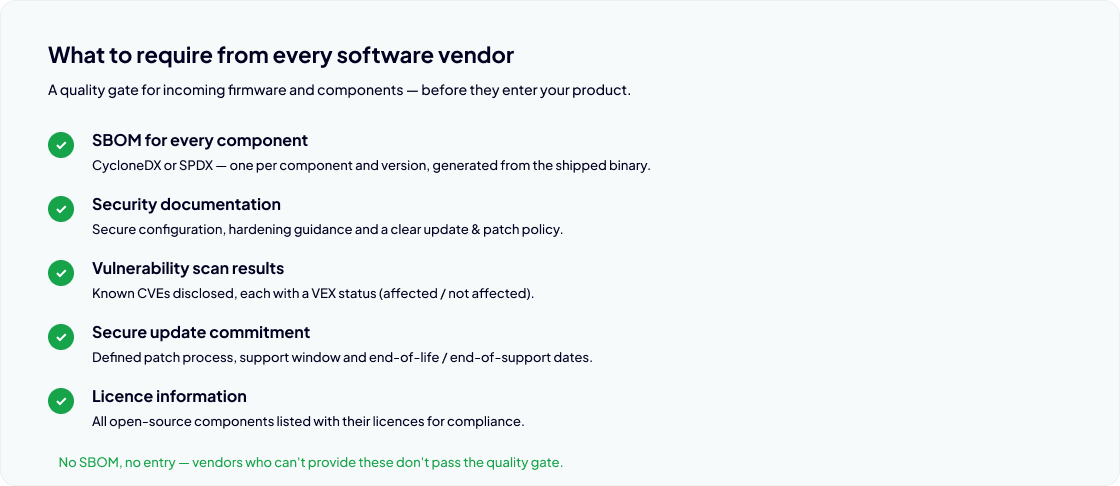
Don’t just trust, verify. Use tools that detect anomalies, outdated libraries, and misconfigurations in vendor code. This turns unknowns into manageable risks.
4. Integrating Security into the CI/CD Pipeline
Security can’t be a checkpoint at the end. It must live inside your development pipeline. Integrating security tools into CI/CD lets you catch issues early and often.
Automated checks ensure unsafe builds never make it to production. You can scan for vulnerabilities, licence violations, and policy conflicts during each commit. This saves time and reduces rework.
Teams that embed security directly into DevOps release faster and safer. It also helps with regulatory compliance. Security gates become part of your workflow, not a blocker.
5. Compliance-Driven Vulnerability Management
Vulnerability management is no longer optional. You need clear processesto detect, assess, and fix known issues. Traditional methods are too slow for modern firmware and embedded software.
Look for tools that:
- Continuously monitor for new CVEs
- Automatically link vulnerabilities to SBOM components
- Prioritise fixes based on real-world risk
Using automated vulnerability management ensures new CVEs are addressed quickly. It supports incident response and limits exposure. It’s a pillar of any strong product security program.
Common Pitfalls to Avoid in Supply Chain Security
Many teams overlook inherited components. If you rely only onsource-level tools, you miss what’s inside binaries. This creates blind spotsthat attackers exploit.
Another mistake is treating SBOMs as static documents. SBOMs must evolve with each update or patch. Outdated data leads to false confidence and missed risks.
Lastly, avoid siloed ownership. Supply chain security is not just IT’s job or compliance’s job. It requires shared responsibility across engineering, security, and product teams.
Role-Based Best Practices
Each role in your organisation plays a part in securing the software supply chain. These tailored practices help leaders focus on what matters most in their domain. Aligning roles with responsibilities strengthens your defence and speeds up action.
%20%E2%80%93%20Light%20(1).png)
PSIRT Manager
You need access to timely vulnerability intelligence. Focus on maintaining a living SBOM and mapping CVEs to affected products. Binary analysis supports your incident response when source data is missing.
Prioritise:
- Automated CVE alerts and triage
- Fast linkage between vulnerabilities and components
- Collaboration with engineering to speed up fixes
The right data shortens mean time to resolution.
Product Owner
You’re responsible for balancing speed, features, and security in every release. From the start of development, request SBOMs to gain visibility into what’s being built and where risks may exist. External components should be verified before integration to prevent introducing vulnerabilities. Security needs to be part of your definition of done, not an afterthought.
Avoid pushing features without passing essential security checks, as this often leads to delays and technical debt later. Collaborate closely with compliance and PSIRT teams to align security and business goals. A roadmap that includes both user needs and regulatory requirements leads to safer, more resilient products.
Product Compliance Manager
Your focus is on proving due diligence. Regulations like CRA and NIS2 demand traceability, documentation, and action. An SBOM is the first step, butnot the last.
Ensure that vulnerability management is ongoing, not a one-time scan. Youneed audit trails that show issues were detected, assessed, and addressed. This supports faster, smoother audits.
Use tools that simplify evidence gathering. Map components to compliance requirements. This makes it easier to show regulators how your products meet security obligations.
Head of Development
Secure coding is only one part of your role. You’re responsible for building CI/CD pipelines that support consistent, scalable security throughout development. Embedding tools like SBOM generation and binary analysis into your workflows helps detect issues early and maintain high release quality. These practices reduce manual effort and keep engineering teams focused on shipping safe, compliant code.
Your teams should also be trained to assess third-party risk and choose secure dependencies. Establish internal policies that reflect your threat model and security goals. Security must be designed into your development process from day one.
CTO & CIO
You’re responsible for the organisation’s long-term resilience. Software supply chain security best practices are essential to protect IP, customers, and brand. Treat security as a business enabler, not a cost.
Focus your investments on:
- Tools that automate visibility and compliance
- Integrations that scale with your development process
- Capabilities that support CRA, NIS2, and future mandates
Proactive investment now prevents reactive fire drills later.
Future-Poofing Your Product Security with ONEKEY
%20%E2%80%93%20Light.png)
ONEKEY helps you automate security across the entire product lifecycle. From SBOM creation to vulnerability detection, it covers both build and binary analysis. This gives you full visibility, even for legacy or third-party code.
You can integrate ONEKEY into Jenkins, Jira, and other CI/CD tools. This embeds security into daily workflows without slowing teams down. It also reduces cost and human error through smart automation.
ONEKEY supports secure development, faster audits, and confident incident response. Whether you’re building new products or securing old ones, it fits your needs. It’s how you stay ready for today’s and tomorrow’s threats.
Conclusion: From Reactive to Proactive Supply Chain Security
Securing the software supply chain is now a core part of product development. You can no longer rely on assumptions, siloed processes, or outdated tools. Visibility into components, automation of analysis, and integration with your workflows are now essential. These are not optional add-ons, they are baseline requirements.
Start with SBOMs to establish transparency and build trust. Extend that visibility through binary analysis, especially for third-party or legacy components. Add CI/CD security gates and role-based workflows to ensure ongoing protection. By adopting software supply chain security best practices, you protect your code, your users, and your compliance posture.
Does Software Supply Chain Security slow down our development cycles?
No, not if you embed it into your development pipeline. Automated tools help identify issues early, so you don’t lose time fixing problems later. With the right integration, supply chain security becomes a time-saver rather than a bottleneck.
How does the Cyber Resilience Act (CRA) affect our SBOM requirements?
The CRA requires continuous visibility into your software components. This means generating and updating SBOMs regularly to show compliance throughout the product lifecycle. Failing to do so could result in penalties or delays in market access.
Can we implement SSCM for legacy products that are already on the market?
Yes, especially through binary analysis techniques. Even if the original development environment is unavailable, you can still reverse-engineer firmware to create SBOMs and assess vulnerabilities. This allows you to bring older products in line with modern security expectations and regulations.
About Onekey
ONEKEY is the leading European specialist in Product Cybersecurity & Compliance Management and part of the investment portfolio of PricewaterhouseCoopers Germany (PwC). The unique combination of the automated ONEKEY Product Cybersecurity & Compliance Platform (OCP) with expert knowledge and consulting services provides fast and comprehensive analysis, support, and management to improve product cybersecurity and compliance from product purchasing, design, development, production to end-of-life.

CONTACT:
Sara Fortmann
Senior Marketing Manager
sara.fortmann@onekey.com
euromarcom public relations GmbH
team@euromarcom.de




Ready to automate your Product Cybersecurity & Compliance?
Make cybersecurity and compliance efficient and effective with ONEKEY.